
What if the most sustainable way to move through the world isn't about what you give up, but what you gain in the quiet spaces between your destinations? Many travelers today feel a deep exhaustion from over-scheduled days, a nagging guilt about their environmental footprint, and a frustration with generic eco-resorts that feel performative. You likely recognize that these hollow labels no longer satisfy the soul. With 67% of travelers now considering environmental impacts, and the EU Empowering Consumers Directive now regulating green claims as of September 2026, the search for a meaningful eco friendly travel itinerary has moved beyond generic slogans.
I believe that travel should be a process of restoration, not depletion. It's about moving through the world with a sense of craftsmanship and care. By shifting your focus from ticking off sights to embracing a deliberate rhythm, you can design a journey that heals both the traveler and the land. In this guide, we will explore how to curate intentional movements that prioritize local connection, light footprints, and unhurried discovery. Together, we will move past the surface to find the true craftsmanship of slow travel.
- Learn to design a travel rhythm that prevents burnout and fosters deep connection.
- Discover how to navigate new regulations to identify authentic, verified partners.
- Identify actionable ways to reduce your footprint through slow movement and rail travel.
- Understand the Mindful Architect approach to planning restorative, off-the-beaten-path escapes.
Key Takeaways
- Understand the shift from passive sustainability to regenerative movement, ensuring your journey actively restores the landscapes and communities you visit.
- Learn how to design an eco friendly travel itinerary that prioritizes unhurried rhythms and sensory depth over the exhaustion of traditional sightseeing.
- Discover the logistical value of shoulder-season timing and microclimate awareness to avoid crowds while preserving the quiet integrity of local spaces.
- Reframe wilderness trails and natural settings as intentional environments for restoration and meditation rather than just physical exercise.
- Explore how bespoke coordination for solo journeys, retreats, and skillcations can transform a generic trip into a deeply personal narrative.
Beyond the Green Label: Defining the Eco-Friendly Itinerary
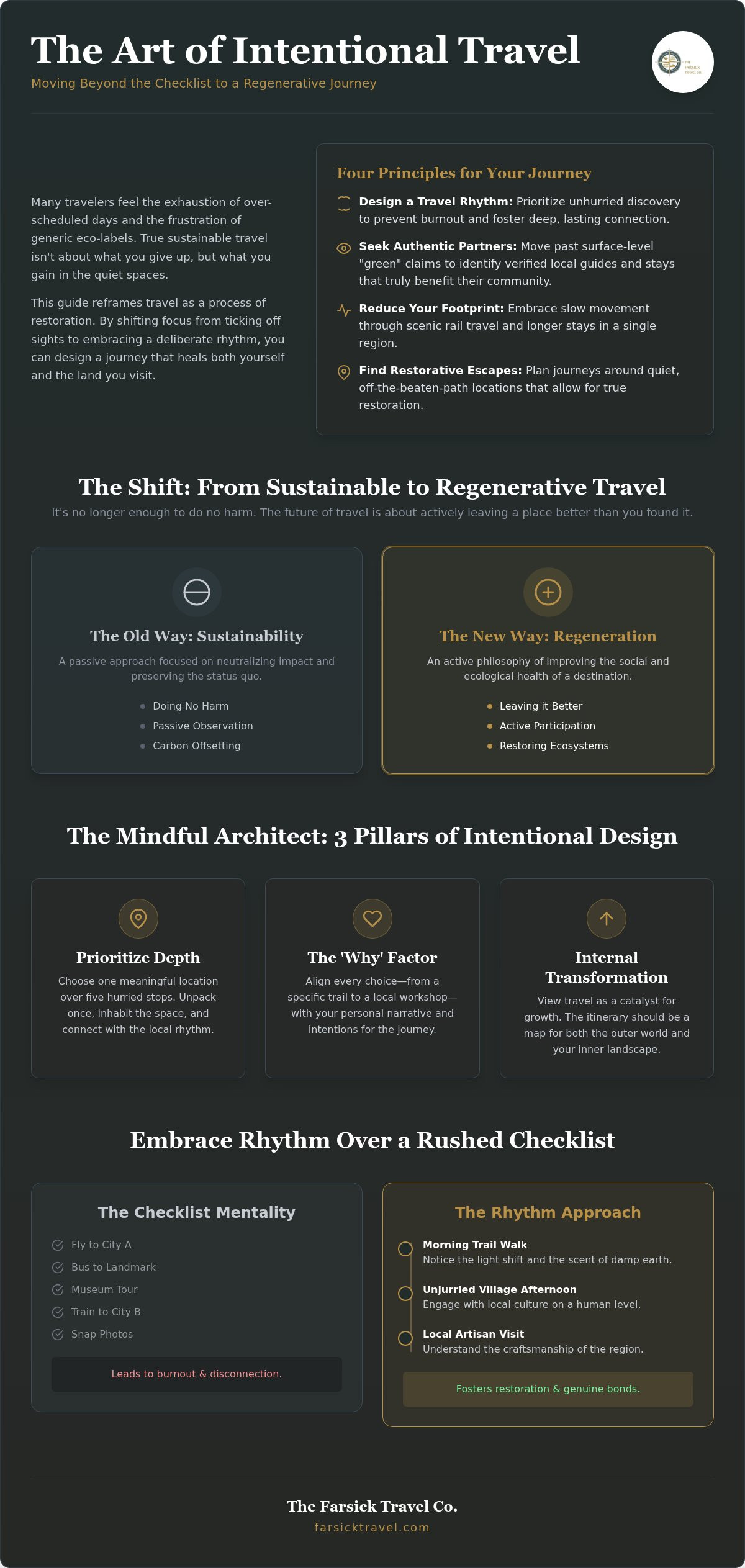
The term "eco-friendly" often feels like a shallow marketing label rather than a lived experience. A genuine eco friendly travel itinerary is not a list of products; it is a design for regenerative movement and local harmony. You might wonder, What is sustainable tourism? While the traditional definition focuses on neutralizing impact, we advocate for a shift toward regeneration. Sustainability is about doing no harm. Regeneration is about leaving a place better than you found it. This requires a transition from passive observation to active participation in the health of a destination.
At The Farsick Travel Co., we approach this through the lens of a Mindful Architect. This persona blends the precision of logistics with the soul of a worldly mentor. We don't just book rooms; we curate environments that foster connection. This process starts with intentionality. It is the foundation of every journey we design, ensuring that every mile traveled serves a higher purpose for both you and the earth.
The Pillars of Intentional Travel Design
Designing a journey with heart requires moving beyond the surface. We focus on three core pillars to ensure your trip feels premium yet grounded:
- Prioritizing Depth: We choose one meaningful location over five hurried stops. This allows you to unpack once and truly inhabit a space.
- The 'Why' Factor: Every choice, from a specific wilderness trail to a local artisan workshop, should align with your personal narrative.
- Internal Transformation: We view travel as a catalyst for personal growth. Your itinerary should reflect the person you wish to become.
Why Your Travel Rhythm Matters More Than Your Checklist
The pace of your journey is your most powerful tool for sustainability. A slow pace drastically reduces the carbon footprint associated with constant transit between cities. When you aren't rushing to the next train or car, you have the space to engage with the local culture on a human level. You notice the subtle shift in light during an unhurried village afternoon or the specific scent of a damp forest floor after a morning rain. This unhurried movement creates a bond with the destination that a checklist can never provide. Travel rhythm is the steady heartbeat of a sustainable journey that balances the thrill of discovery with the grace of restorative rest.
The Sensory Architecture of Nature-First Planning
Most travel is planned through a digital screen, prioritizing what a place looks like over how it feels. A truly restorative eco friendly travel itinerary reverses this. It begins with the sensory architecture of a destination. We look for settings that foster unhurried restoration, where the environment dictates the pace of the day. In this framework, wilderness trails are not merely tracks for physical exertion; they are cathedrals for meditation. We choose locations based on microclimates and authentic scents that ground you in the present moment. This approach ensures that your journey isn't just a series of stops, but a sequence of textures and sounds that soothe the nervous system.
The Mindful Architect views every landscape as a delicate balance of biology and history. This requires a commitment to Leave-No-Trace (LNT) ethics as a non-negotiable design constraint. We don't view these principles as a set of restrictive rules, but as an ethical framework that protects the very beauty we seek to experience. By prioritizing off-the-beaten-path locations, we avoid the heavy footprint of mainstream tourism and find spaces where the land's original voice is still audible.
Designing for the Five Senses
To create a journey that resonates, we focus on the specific sensory details that define a region's soul. We look for the sharp, resinous scent of damp pine needles after a mountain rain or the heavy, humid air that clings to a canyon floor at dawn. Instead of chasing broad vistas, we invite you to notice the intricate patterns of lichen-covered granite or the way light filters through the canopy to illuminate the forest floor. You might listen for the low hum of wind through tall grass or the rhythmic clatter of a local village market waking up. These details create a sense of place that generic adjectives cannot capture. If you're ready to move beyond the visual and inhabit a landscape, you can reach out to begin your sensory journey.
Leave-No-Trace: The Planner's Ethical Framework
Planning for minimal impact in sensitive ecosystems is a core responsibility. We prioritize accommodations that blend into the landscape, using natural materials and low-profile designs that respect the horizon line. Our process includes educating travelers on specific seasonal vulnerabilities, such as avoiding certain trails during the spring thaw to prevent soil erosion or respecting wildlife boundaries during nesting periods. We also suggest practical logistics for crowd-avoidance, such as visiting popular natural springs at sunrise when the light is soft and the water is undisturbed. This level of detail ensures that your presence is a gift to the destination, not a burden.
- Choose footwear with non-marking soles to protect soft sandstone or delicate mosses.
- Pack reusable, lightweight containers to eliminate single-use plastics in remote wilderness areas.
- Plan for sunrise or twilight visits to natural landmarks to experience the terrain in its most quiet, authentic state.
Choosing Depth Over Distance: The Rhythm of Sustainable Exploration
The modern traveler often falls into the trap of the checklist. It's a frantic race to see everything while feeling as though you've seen nothing at all. Designing an eco friendly travel itinerary requires a fundamental shift in perspective. Instead of measuring success by the number of stamps in a passport, we measure it by the depth of the connection formed. Spending four nights in a single valley allows you to learn the language of the wind in the trees and the names of the people who bake the bread. This is the antithesis of the four-city-in-one-week sprint that leaves both the traveler and the destination exhausted.
Professional coordination is the silent engine behind this unhurried pace. It removes the logistical friction that typically causes travel burnout, such as misaligned transport times or overcrowded transit hubs. By handling the complex architecture of movement, a Mindful Architect ensures your focus remains on the experience rather than the logistics. This high-touch planning transforms the "unhurried afternoon" from a luxury into a core component of your journey.
The Anatomy of a Slow Day
We structure our days to mirror the natural rhythms of the landscape. This intentionality prevents the sensory overload that often accompanies mass-market travel. A typical slow day might look like this:
- Mornings: Dedicated to the soft, amber light that grazes the ridges of wilderness trails. It's a time for quiet movement, where the only sound is the crunch of gravel or the distant call of a bird.
- Mid-days: Reserved for unhurried local interactions or skill-learning. This might involve a skillcation workshop, where you learn a traditional craft from a local artisan, or a long conversation in a village square.
- Evenings: Centered around restoration. These hours are defined by seasonal, locally sourced nourishment and the space to reflect on the day's internal shifts.
Fast Travel vs. Slow Travel: An Impact Comparison
The impact of your travel pace is measurable and profound. Fast travel relies on frequent transit and rapid movement, which significantly increase carbon emissions per day. In contrast, choosing regional rail or staying within a single landscape preserves the air and the local peace. Beyond the environment, your presence has a different economic weight. "Drive-through" tourism often leaves behind little more than surface-level consumption. "Stay-awhile" tourism ensures your economic contribution reaches local families directly, supporting heritage and conservation efforts. Our slow travel planning service is designed to help you build these bespoke rhythms, turning a standard trip into a regenerative legacy that benefits the destination as much as the traveler.
Practical Foundations: Logistics for a Low-Impact Journey
Logistics often feel like the least romantic part of a trip, but they are the quiet scaffolding of a meaningful eco friendly travel itinerary. Without a solid plan, the search for authentic experiences often leads to the same crowded overlooks as every other traveler. True intentionality requires understanding the seasonal nuances and daily rhythms of your destination. By choosing to travel during the shoulder season, you avoid the heavy pressure of peak-season crowds while enjoying the subtle, evocative shifts in the landscape. This timing protects the local peace and allows for a more intimate connection with the terrain.
Optimal Timing and Crowd Avoidance
We prioritize dawn and dusk for wildlife viewing and trail movement. These hours respect the natural cycles of local fauna and offer a quality of light that transforms a simple walk into a meditative experience. Identifying over-touristed dates, such as major national holidays or local festival weekends, is essential for preserving the integrity of the destination. Choosing a mid-week escape distributes economic benefits more evenly across the week, reducing the strain on local infrastructure and staff during traditional weekend surges. This approach ensures your presence remains a benefit rather than a burden.
Packing for the Intentional Traveler
Packing for an eco friendly travel itinerary is an exercise in curation. We prioritize high-quality, long-lasting gear that serves multiple purposes, moving away from the culture of disposables. A minimalist kit for wilderness and wellness retreats should include sensory tools that ground you in the present. Consider carrying a field guide to local flora, a high-quality sketchbook, or precision optics for birdwatching. These items encourage a slower pace and deeper observation of the microclimates you encounter.
Microclimates require a layered approach to clothing. Instead of packing for every possible disaster, focus on versatile pieces that can handle the cool, humid air of a morning valley and the dry heat of an afternoon ridge. This self-sufficiency is vital for off-the-beaten-path exploration, where the nearest shop might be a day's journey away. Preparation is the bridge between anxiety and unhurried discovery, allowing you to move through the world with quiet confidence.
Begin designing your custom low-impact journey
Cultivating Connection: How The Farsick Travel Co. Designs Your Journey
The transition from a standard vacation to a deeply resonant eco friendly travel itinerary requires more than a booking engine; it requires a partnership. We view the design process as a collaboration between the Mindful Architect and the traveler. This isn't about choosing from a pre-set menu of tourist stops. Instead, it's about a thorough exploration of your "why." We work with you to understand the specific rhythms that restore your spirit, whether that involves solo wilderness trails or quiet village afternoons. This high-touch approach ensures that every logistics decision, from the choice of local transport to the specific microclimate of your stay, aligns with your personal narrative.
Our Signature Retreats and Skillcations
For those who seek a sense of community alongside their restoration, our Signature Hiking & Yoga Retreats offer a curated environment for connection. We move away from the high-energy, crowded atmosphere of traditional group tours. Instead, we focus on small-group experiences that feel like a gathering of friends. These journeys integrate specialized instruction, such as guided wilderness meditation or local craft workshops, directly into the flow of the day. Our hosts act as worldly mentors, ensuring the rhythm stays unhurried and meaningful. You won't find a rigid schedule here. You'll find a sequence of moments designed to foster both internal transformation and deep harmony with the land.
Skillcations add another layer of meaning to your eco friendly travel itinerary. These are intentional escapes where you learn a new craft or deepen a practice in its place of origin. Whether it's mastering local culinary techniques or practicing yoga on a salt-misted coastline, these experiences create authentic local interactions that go beyond the surface. By focusing on the craftsmanship of the experience, we help you move from the state of "farsick"—that deep longing for a place you've never been—to a frictionless reality that feels like home.
Beginning Your Bespoke Journey
The beauty of a custom journey lies in the details. We handle the end-to-end coordination of your transport, stays, and unique activities, removing the friction that often leads to travel burnout. This allows you to remain fully present in the sensory details of your environment. If you're ready to design a journey that leaves a light footprint while offering a heavy sense of purpose, we invite you to take the first step. You can fill out our custom planning form to share your vision with us. For a more direct conversation, schedule a consultation to begin designing your unhurried escape with The Farsick Travel Co.
Embrace the Rhythm of Intentional Movement
The transition from a standard vacation to a deeply restorative journey begins with a single, intentional choice. You've discovered that a true eco friendly travel itinerary is not a list of restrictions; it is a framework for regeneration and sensory depth. By prioritizing the rhythm of your days over the length of your checklist, you protect the quiet integrity of the world's most delicate landscapes. This approach transforms travel from a source of burnout into a catalyst for internal growth and environmental restoration.
Our expertise in regenerative travel ensures that every detail of your escape is handled with craftsmanship and care. We provide bespoke journey curation and high-touch, end-to-end coordination to remove the friction of logistics, leaving you free to inhabit the present moment. Whether you seek a solo wilderness retreat or a skillcation focused on local heritage, the path forward is one of unhurried discovery.
Start planning your intentional escape with The Farsick Travel Co.
The world is waiting for you to move through it with grace. It's time to turn your longing for connection into a lived reality that honors both the traveler and the destination.
Frequently Asked Questions
What is an eco-friendly travel itinerary?
An eco friendly travel itinerary is a curated design for regenerative movement and local harmony. It moves beyond the simple "do no harm" philosophy of traditional sustainability to actively restore the destinations you visit. This involves selecting off-the-beaten-path locations, utilizing low-impact transport like regional rail, and designing a daily rhythm that respects both the land's seasonal vulnerabilities and your own need for unhurried restoration.
How can I make my travel itinerary more sustainable?
You can increase sustainability by choosing depth over distance. Instead of a multi-city sprint, spend four or more nights in a single location to reduce transport emissions and deepen your economic contribution to the local community. Focus on unhurried afternoons, use Leave-No-Trace ethics as a design constraint, and prioritize authentic local interactions over mainstream tourist spots. Selecting high-quality, long-lasting gear rather than disposables also significantly lightens your footprint.
Is slow travel more expensive than traditional travel?
Slow travel is an investment in quality and craftsmanship rather than a high volume of sights. While the per-day cost may be higher due to the selection of bespoke accommodations and high-touch local activities, you often save on the hidden costs of frequent, last-minute transit. The value lies in the restoration and connection you gain, which prevents the burnout often associated with cheaper, mass-market itineraries that require a vacation from your vacation.
Can I plan an eco-friendly itinerary for a solo trip?
Solo travel is an ideal canvas for an eco friendly travel itinerary because it allows for total alignment with your personal rhythm. Without the pressure of a group's checklist, you can spend hours on a single wilderness trail or a quiet village square. We specialize in solo travel experiences that provide the safety of professional coordination while maintaining the unhurried, reflective pace necessary for internal transformation and deep connection with nature.
What are the best destinations for nature-based travel in the US?
The United States offers diverse microclimates and landscapes perfect for nature-first planning. We look for off-the-beaten-path locations that offer sensory depth, such as the humid, moss-draped forests of the Pacific Northwest or the lichen-covered granite ridges of the Appalachian range. The key is to avoid over-touristed national park hubs during peak dates and instead seek out wilderness areas where you can experience the land's original voice in quiet solitude.
How do I avoid over-tourism while still seeing beautiful places?
Avoiding over-tourism requires a commitment to shoulder season travel and mid-week escapes. By visiting popular regions when the crowds have thinned, you preserve the local peace and reduce the strain on infrastructure. We also recommend seeking out rural alternatives that offer similar geological beauty without the heavy footprint of mainstream tourism. This intentionality ensures your visit supports the destination's long-term health rather than contributing to its depletion.
What should I look for in an eco-friendly accommodation?
Prioritize accommodations that blend into the landscape using natural materials and low-profile architecture. Look for partners who have verified, third-party sustainability certifications, especially in light of the 2026 EU Empowering Consumers Directive which regulates green claims. Authentic eco-stays focus on regenerative practices, such as water conservation in arid microclimates and supporting local wildlife boundaries, rather than just offering performative green labels or towel-reuse programs.
How does a travel planner help with sustainability?
A professional planner acts as a Mindful Architect, handling the complex logistics that ensure a low-impact journey. We provide end-to-end coordination of regional transport and unique local activities, removing the friction that leads to wasteful, last-minute decisions. By vetting partners for genuine regenerative practices and identifying off-the-beaten-path locations, we help you transition from a farsick longing for travel to a curated reality that prioritizes connection, meaning, and unhurried movement.
Article by
Ursula Akin
Ursula Akin created The Farsick Travel Co. to help travelers step away from rigid, multi-stop checklists and step into intentional, deeply rooted experiences. Specializing in custom travel design, solo escapes, and curated retreats, Ursula combines local insights with leave-no-trace ethics to turn wanderlust into seamless, unforgettable journeys.
Disclaimer
The information provided on this website and within our articles is for general informational and inspirational purposes only. While we make every effort to ensure accuracy regarding travel logistics, recommendations, and local details, conditions can change rapidly. Readers are encouraged to verify current travel requirements, weather, safety advisories, and local regulations independently. The Farsick Travel Co. is a travel design and curation service and is not responsible for any actions, changes, or incidents occurring during independent travel.


