

What if the most meaningful part of a trip isn’t a famous landmark, but the unhurried hour that lets you notice how a place lives? Authentic travel experiences often take shape in small moments: a conversation that unfolds naturally, a meal shared with care, or the quiet rhythm of an afternoon.
If you’ve ever wondered whether an encounter is connected to local life or simply arranged for visitors, that hesitation makes sense. A packed itinerary can leave little room to listen, wander, or change pace. Thoughtful travel means approaching people, culture, and nature with respect, not treating them as attractions to collect.
This guide will help you recognize what makes an experience feel reciprocal and rooted in place, then plan for more of those moments. You’ll find practical ways to choose a gentler itinerary, make room for discovery, and travel with consideration for the communities and landscapes you visit. The goal isn’t to see everything. It’s to come away feeling more connected to somewhere, and to your own way of moving through it.
Key Takeaways
- Look for authentic travel experiences grounded in context, mutual respect, and local knowledge, rather than promises of exclusive access.
- Explore how food, craft, nature, or learning can offer different ways to connect with a place.
- Notice whether an experience makes room for consent and local involvement, without judging a culture by visitor expectations.
- Shape a natural itinerary by choosing a purpose, setting, and a few meaningful experiences, then leaving breathing room.
- Match your travel style, from a solo journey to a retreat or skillcation, with a pace that supports the connections you want to make.
What Makes Authentic Travel Experiences Feel Different?
Authentic travel isn’t a special kind of place or a promise of access to someone else’s private life. It’s an attentive way of meeting a place: noticing its context, approaching people with respect, and staying curious about what you don’t yet understand. A useful definition is simple: authentic travel is respectful, curious engagement with a place that leaves room for its people and rhythms to be their own.
That distinction matters. A famous landmark can be meaningful when you learn what it represents and why it matters; an obscure activity isn’t automatically more genuine because it’s unusual. Reading about experiential travel offers a related perspective on immersion and engagement, but no single experience can stand in for a whole culture. Places are varied and evolving, not exhibits with one approved version of local life.
Authentic travel is a way of relating, not a destination label
Listening changes the texture of a moment. A conversation with a guide, a question about a dish, or time spent learning a craft can reveal context that a photograph alone can’t hold. The exchange may be brief, but it becomes more meaningful when curiosity is paired with attention and respect.
That doesn’t require a remote setting, discomfort, or access to private routines. Residents don’t owe visitors a performance of everyday life. Choose experiences where local people shape what’s shared, and accept a polite boundary without pressing for more.
Why travelers seek connection beyond the checklist
A checklist rewards movement from one attraction to the next. Connection asks for a different pace: enough time to notice the sounds of a market, the changing light on a walk, or how the landscape shifts between a settled area and a trail. These details can help you understand a setting without claiming to know it completely.
Meaning often comes from participation with context, not simply being present. A guided walk can deepen appreciation of a landscape when you follow the route, respect wildlife, and leave what you find undisturbed. A meal can prompt a thoughtful exchange when you listen as readily as you ask. Neither moment guarantees transformation. Both can make a journey feel more personal.
Before choosing an activity, try this quick check:
- Context: Will you learn why this place or practice matters, rather than just watch it?
- Consent: Are people choosing what they share, with clear boundaries?
- Reciprocity: Is local knowledge valued, and does your presence respect the setting?
If the answers aren’t clear, stay curious rather than demanding proof of “authenticity.” The aim isn’t to collect unusual encounters. It’s to travel with enough attention to meet each place as it is, not as you hope it will be.
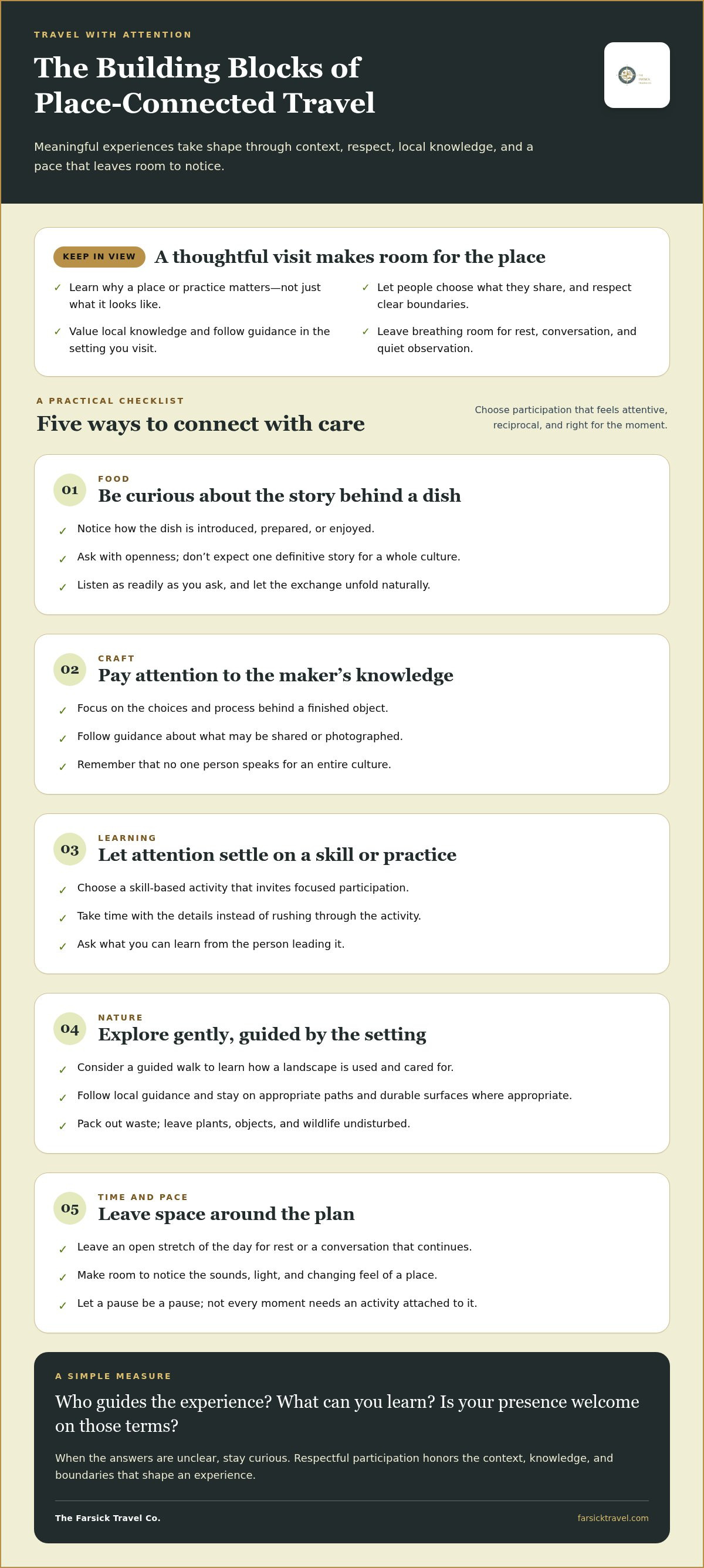
The Building Blocks of Meaningful, Place-Connected Travel
Connection grows from more than a well-chosen activity. It depends on context, respect, local knowledge, and a pace that lets you take them in. A visit can be thoughtfully arranged and still leave room for ordinary life: a relaxed meal after a planned activity, time to explore at your own pace, or a quiet pause before heading on.
Respectful participation helps you understand an experience by honoring the context, knowledge, and boundaries that shape it. That’s a useful measure for authentic travel experiences. Rather than asking whether something feels “local” to a visitor, consider who guides it, what you can learn, and whether your presence is welcome on those terms.
Local culture and everyday encounters with context
Food, craft, and cultural activities can offer more than a photo opportunity when they’re shaped by people who choose to share their knowledge. A cooking session, for example, might reveal how ingredients and techniques connect to a particular place; a craft demonstration may open a window into the choices behind a finished object. Stay curious, listen closely, and remember that no one person speaks for an entire culture.
Consent and fair participation matter, too. Choose encounters with clear boundaries, follow guidance about what may be shared or photographed, and accept that some parts of community life aren’t for visitors.
- Food: Notice how a dish is introduced, prepared, or enjoyed. Ask questions with openness rather than expecting a single definitive story.
- Craft: Focus on the maker’s knowledge and process, not only on taking home an object or image.
- Learning: A skill-based activity can turn observation into focused participation, whether the subject is movement, making, or another practice.
- Nature: A guided walk can help you notice how a landscape is used and cared for. Stay on appropriate paths, pack out waste, and observe wildlife without disturbing it.
Nature, learning, and slower moments
Learning gives attention somewhere to settle. Instead of rushing through an activity, take time to notice its details and ask what you can learn from the person leading it. In natural spaces, follow local guidance, keep to durable surfaces where appropriate, and leave plants, objects, and wildlife undisturbed.
Then leave room around the plan. An open stretch of the day lets a conversation continue, gives you time to rest, or simply makes space to notice what’s around you. Not every pause needs an activity attached to it.
A custom journey can bring those choices together, balancing planned experiences with time to breathe. The Farsick Travel Co.’s custom travel planning can coordinate activities, stays, and transport around a more considered rhythm.
How to Tell a Genuine Experience from a Staged One
An experience can be planned, polished, and meaningful. It can also be marketed with words like “exclusive” or “authentic” without explaining what those promises mean. Rather than trying to judge a culture from the outside, look for practical cues: who shapes the activity, what context is offered, and how visitors are expected to participate. These signs can help you choose authentic travel experiences without treating any community as a test of what feels “real.”
Questions that reveal how an experience is shaped
Before you join an activity, notice how clearly it’s described. Who leads it, and whose knowledge or perspective will you hear? Does the description explain what you’ll learn or do, or does it rely mostly on claims of hidden access and “untouched” culture? Specific, grounded details are more useful than grand promises.
Pay attention to boundaries, too. A thoughtful experience makes clear how participants should engage with people and place. It doesn’t pressure residents to pose, share personal stories, or perform private routines. In natural settings, look for guidance that encourages considerate behavior and care for wildlife and surroundings.
Look for
Pause over
Clear context: The description explains the activity and what you’ll learn.
Vague promises: “Exclusive authenticity” is emphasized without saying what participation involves.
Visible local involvement: Local knowledge and leadership are part of the experience.
Unclear representation: It’s difficult to tell whose perspective is being presented or who sets the terms.
Respectful boundaries: Expectations around interaction, photography, and the setting are clear.
Intrusion as entertainment: People, traditions, or wildlife seem presented for visitors without attention to consent or care.
Authenticity without romanticizing local life
Everyday life is complex and changing. It isn’t a fixed scene waiting for visitors, and no single guide, host, or encounter can represent an entire community. A place doesn’t become more meaningful because it’s remote, uncomfortable, or unfamiliar to you. Poverty and inconvenience aren’t proof of authenticity; they’re not experiences to seek out or use as evidence of a “real” destination.
Planning doesn’t make an encounter false, either. A well-organized visit can support a considerate exchange, while an unplanned arrival can still be intrusive. What matters is how the experience is shaped and how you meet it.
If reality differs from your expectations, let that difference prompt a question rather than a verdict. Listen, follow the host’s guidance, and allow the place to be more varied than the story you arrived with. That humility is a more reliable compass than any promise of an experience untouched by visitors.
How to Plan Authentic Travel Experiences with a More Natural Rhythm
Good planning doesn’t mean filling every hour. It means deciding what deserves your attention, then arranging the practical details so the day can unfold without a constant rush. Use this sequence to shape authentic travel experiences around your interests while leaving space for the unexpected.
- Name your purpose. Decide what you want more of: time outdoors, learning a skill, thoughtful cultural exchange, or a quieter pace. A clear intention helps you choose what belongs in the itinerary and what doesn’t.
- Choose a setting that supports it. Consider the kind of landscape, community, or environment you want to spend time in. Look beyond the most familiar hubs, but don’t treat remoteness as a measure of meaning.
- Select a few anchors. Choose activities that give the trip shape, such as a guided walk, a class, or time with a local host. Check how they fit with transport and accommodation, so getting from one place to another doesn’t become the day’s main event.
- Leave breathing room. Keep open stretches in the schedule for rest, a longer conversation, a change in weather, or an inviting side street. Flexibility creates options without requiring you to chase a so-called secret spot.
Shape a day around one anchor and room to wander
Picture a morning walk followed by an unhurried afternoon. The walk gives the day a focus; the open afternoon lets you pause for lunch, explore nearby at your own pace, or return to your accommodation to rest. This is a template, not a prescription. Match the anchor to your energy and interests, and let the rest of the day breathe.
Fewer transitions help. Each transfer, timed entry, and tightly scheduled stop asks you to shift attention. For popular sites or activities, check local opening patterns and consider arriving early or later in the day, when visitor flow may be lighter. Timing varies by place and season, so use current local information rather than assuming a quiet hour.
Prepare thoughtfully for season, setting, and impact
Before finalizing activities, check current seasonal conditions for your chosen setting. Daylight, weather, trail conditions, and local operating rhythms can all influence what feels comfortable or appropriate. If conditions change, be ready to adjust the plan rather than forcing an outing to fit the itinerary.
Pack for the activities you’ve chosen and the conditions you’ve researched. Adaptable layers, comfortable activity-appropriate footwear, and reusable essentials can serve across a range of days. Add personal items you need for the setting, and avoid packing as though every possible activity must happen.
In natural spaces, follow local guidance, stay on appropriate paths, pack out waste, and give wildlife room. Thoughtful preparation supports both a calmer experience and a lighter footprint.
Plan a custom itinerary with The Farsick Travel Co.
Design a Custom Journey Around the Experiences You Want to Remember
A journey becomes more personal when its shape reflects what you hope to notice, learn, or feel. Start with the connection you’re seeking, then let that purpose guide the destination, activities, places to stay, transport, and pace. The Farsick Travel Co. designs custom journeys around individual preferences, bringing the pieces together without turning every day into a checklist.
Match the journey to the connection you hope to make
Ask yourself what you want more room for: time in nature, learning a skill, solitude, wellness, or sharing the journey with others. A nature-based adventure might center on time outdoors and a gentle pace between activities. A solo trip could leave more freedom to follow your curiosity, while a skillcation makes learning part of the journey’s purpose. A retreat can give wellness a clearer rhythm.
There’s no need to choose only one interest. The useful question is which should lead, and which can complement it.
Turn meaningful intentions into a coordinated itinerary
Once you know the purpose, the details can support it. The Farsick Travel Co. coordinates transport, accommodations, and activities as part of custom travel planning. That means the journey’s structure can reflect how you want to spend your time, rather than asking you to fit your priorities around a preset sequence. For further ideas on shaping a trip around personal preferences, explore the article’s guidance on custom itinerary design.
Different travel styles call for different arrangements. Signature hiking and yoga retreats bring movement and restoration together; solo travel offers a journey shaped around your own interests. Skillcations make learning central, while proposal and honeymoon planning can give a shared milestone its own considered pace. Intentional group and bachelorette trips can balance time together with space to unwind.
Before planning, gather a few useful notes: what you most want to remember, the pace that feels right, activities you’d like to include, and anything you’d rather leave out. A tailored planning conversation can turn those preferences into a coherent itinerary, with the practical details serving the experience rather than crowding it.
Choose the kind of journey you want to make, and begin planning a custom itinerary or retreat with The Farsick Travel Co.
Schedule a custom trip planning conversation
Let Your Next Journey Begin with Intention
The next trip doesn’t need to start with a packed itinerary. Begin with a quieter question: what would you like to make room for? Perhaps it’s the freedom to follow your curiosity, the steadiness of time outdoors, or the pleasure of learning something unfamiliar. That intention can become a compass as you make choices, leave space between plans, and decide what deserves your attention.
Authentic travel experiences aren’t something you can guarantee in advance. You can, though, travel with openness and care, ready to meet a place without asking it to match a fixed idea. Let the small discoveries count: a conversation that stays with you, a lesson that changes how you notice things, or a stretch of unscheduled time that feels entirely your own.
When you’re ready to shape that intention into a journey, The Farsick Travel Co. can help create a custom itinerary or retreat around what matters to you.
Take the first step at your own pace. A more meaningful way to travel can begin with one clear intention and the room to follow it.
Frequently Asked Questions
Is authentic travel the same as living like a local?
“Living like a local” is often used to describe cultural immersion, but it isn’t a requirement or a reliable measure of meaningful travel. Treat it as an invitation to learn, not a checklist: choose a topic you genuinely care about, such as food traditions or design, and read a little before you go. The phrase can mean different things to visitors and hosts, so let your understanding stay open.
Can authentic travel be comfortable and well planned?
Yes. A well-planned trip can feel comfortable and still leave room for discovery. Decide what helps you feel rested, such as a familiar room setup or a lighter day after transit, and build that into the schedule. Keep one flexible block rather than stacking reservations. Practical ease can support attention without dictating what you’ll find meaningful. Choose your priorities before adding optional activities.
Do you need to speak the local language for an authentic travel experience?
No. Speaking the language can make some interactions easier, but respectful connection doesn’t depend on fluency. Before you leave, write down a greeting, a thank-you, and a simple way to ask for help in the language used at your destination. Keep the phrases accessible, try them with humility, and listen to the reply. If communication is difficult, don’t assume someone has time to interpret.
How can travelers avoid turning local culture into a tourist attraction?
Learn about an activity before deciding whether it suits you. Read its description for who organizes it, what participation involves, and how the host’s perspective is presented. You can also look for background from cultural institutions or the activity’s organizers, rather than relying only on promotional images. During the experience, follow the format offered and avoid treating a person, object, or tradition as a prop for your own story.
Can a short trip still include authentic travel experiences?
Yes. A short visit can still make room for authentic travel experiences if you give it a clear focus. Choose one question to guide your curiosity, such as how a local craft is made or what shapes a landscape, and let that inform what you read, notice, or ask. Keep arrival and departure days realistic, too, so delays or fatigue don’t turn a brief trip into a race.
What should I pack for a nature-based travel experience?
Start with the activity’s own guidance, then check the destination’s current conditions close to departure. Requirements can differ between a walk on maintained paths and a longer outing, so don’t assume one gear list fits both. Consider sun or rain protection if the forecast calls for it, and bring personal essentials you rely on. Pack so you can carry your belongings comfortably without leaving anything behind outdoors.
Does authentic travel have to mean going off the beaten path?
No. A less-visited destination isn’t automatically a better fit, and well-known places can offer plenty to learn. Before choosing a quieter alternative, look at current visitor guidance and whether access is permitted. Avoid following online directions to fragile or restricted sites just to find somewhere uncrowded. You can also seek out deeper interpretation at an established public site, rather than adding another stop simply because it’s less familiar.
Ready to shape a journey around the experiences you want to remember? Plan a custom itinerary or retreat with The Farsick Travel Co.
Article by
Ursula Akin
Ursula Akin created The Farsick Travel Co. to help travelers step away from rigid, multi-stop checklists and step into intentional, deeply rooted experiences. Specializing in custom travel design, solo escapes, and curated retreats, Ursula combines local insights with leave-no-trace ethics to turn wanderlust into seamless, unforgettable journeys.
Disclaimer
The information provided on this website and within our articles is for general informational and inspirational purposes only. While we make every effort to ensure accuracy regarding travel logistics, recommendations, and local details, conditions can change rapidly. Readers are encouraged to verify current travel requirements, weather, safety advisories, and local regulations independently. The Farsick Travel Co. is a travel design and curation service and is not responsible for any actions, changes, or incidents occurring during independent travel.


