

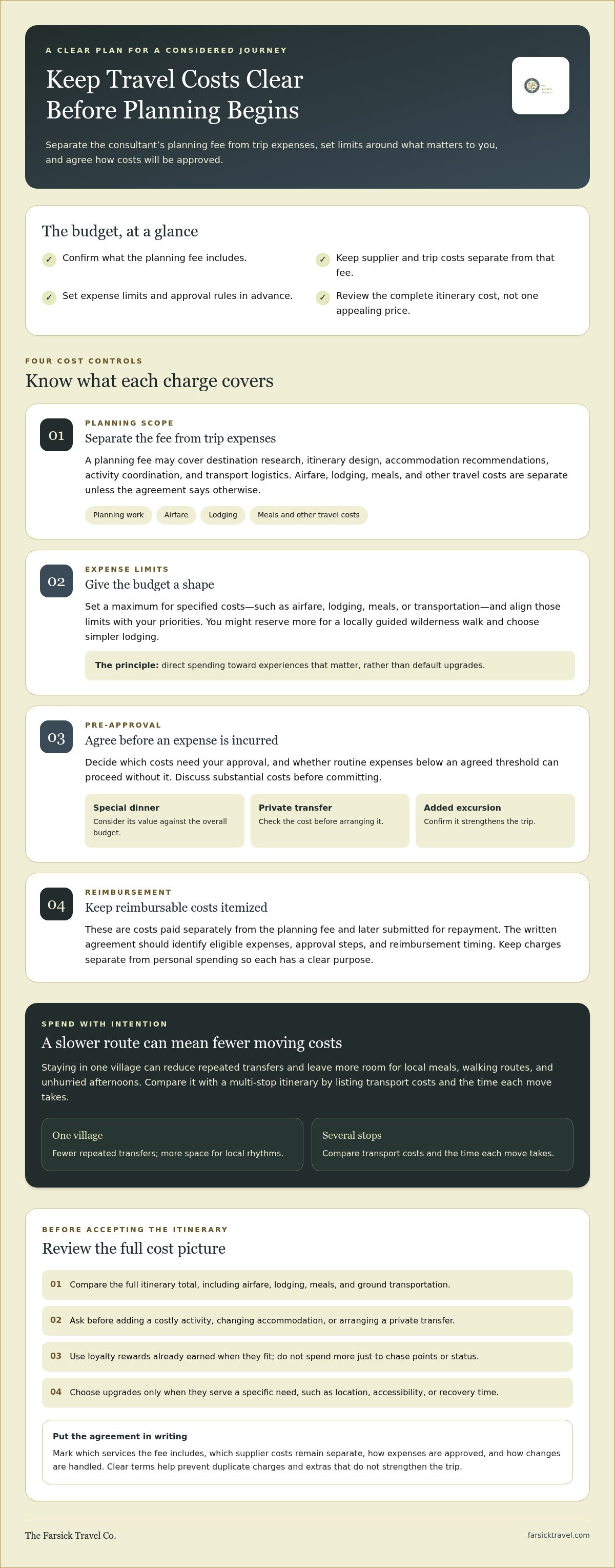
A personal travel consultant’s cost depends on the planning scope and which trip expenses or optional services are included. Before planning begins, agree on the fee, any separate expenses, and how costs will be approved. That keeps the budget clear.
It’s reasonable to want thoughtful guidance without paying for extras that do not improve the trip. The best measure is not simply the lowest fee, but whether the planning saves time, reduces friction, and creates an experience that feels right for you.
This guide explains common fee structures, expenses to consider, and practical ways to avoid unnecessary spending. You’ll also learn how to weigh planning costs against the value of a journey shaped around your pace, priorities, and reasons for going.
Key Takeaways
- Separate the consultant’s planning fee from trip costs, and clarify how expenses are approved and reimbursed before work begins.
- Set a budget around what genuinely supports your trip, so convenience or upgrades don’t quietly crowd out what matters most.
- Compare flat-fee, hourly, and commission structures by the work they cover, not by the billing label alone.
- Understand the terms attached to a consultation fee before assuming it can be refunded or applied to a booking.
- Weigh hands-on planning against self-service options by considering the time, coordination, and personal fit your journey needs.
Avoiding unnecessary travel spending
A personal travel consultant’s fee covers the planning work set out in the agreement, not automatically every trip expense. It may cover destination research, itinerary design, accommodation recommendations, activity coordination, and transport logistics. Airfare, lodging, meals, and other travel costs are separate unless included.
An expense cap sets the maximum amount for a specified travel cost. Set limits for airfare, lodging, meals, or transportation before planning begins, then align them with your priorities. For example, you might reserve more of your budget for a locally guided wilderness walk and choose simpler lodging. Clear limits help shape an itinerary around meaningful experiences instead of default upgrades.
Pre-approval means getting permission before an expense is incurred. Agree on which costs require approval and whether routine expenses below a set threshold can proceed without it. Discuss substantial costs before committing, even if routine purchases need no advance approval. A special dinner, private transfer, or added excursion can affect the overall budget, so consider its value first.
Reimbursable expenses are costs paid separately from the planning fee and later submitted for repayment. Keep them itemized and separate from personal spending so each charge has a clear purpose. If a consultant incurs costs on your behalf, the written agreement should specify eligible expenses, approval steps, and reimbursement timing. This helps distinguish agreed trip costs from optional extras.
- Compare the full itinerary total, including airfare, lodging, meals, and ground transportation, rather than comparing one attractive price alone.
- Ask for approval before adding a costly activity, changing accommodation, or arranging a private transfer.
- Use loyalty rewards already earned when they fit the trip; don’t spend more just to chase points or status.
- Choose upgrades only when they serve a specific need, such as location, accessibility, or recovery time.
For a slower journey, the best way to save may be to make fewer stops. Staying in one village can reduce repeated transfers and leave more room for local meals, walking routes, and unhurried afternoons. Compare that plan with a multi-stop itinerary by listing transport costs and the time each move takes. The simpler option may better suit both your budget and the rhythm you want.
Before accepting a proposed itinerary, review the scope, expense rules, and approval process together. Mark which services the fee includes, which supplier costs remain separate, and how changes are handled. That simple advance review helps prevent duplicate charges and expenses that don’t strengthen the trip. A clear plan makes each cost easier to understand, assess, and manage.
Balancing cost, perception, and value
Value depends on what the fee covers and how well the plan fits your priorities. Compare the full service, trip expenses, and time saved instead of judging by one number alone.
Before proceeding, review the written scope, service terms, and fee breakdown. Ask how expenses, changes, and reimbursement are handled, and keep the answers with your records.
Consultant Prices and Online Agencies
An online travel agency is a self-service platform for comparing or arranging travel. A personal travel consultant provides tailored planning. The key difference is the work included, not simply the channel.
Compare like with like: a displayed hotel rate may not include itinerary design or tailored recommendations. A consultant’s fee may cover research and coordination, while hotels and other trip expenses remain separate. For example, compare a planned stay, including suitable lodging, local activities, and travel time, with the same components arranged yourself. The useful measure is the complete plan and the effort involved.
Consultant Fee Structures
A flat fee is one set charge for an agreed planning scope. An hourly rate charges for time worked. A commission is compensation tied to a booking or supplier relationship.
Ask what work each structure covers, how revisions are handled, and whether supplier payments create separate expenses. For a quiet, multi-day nature itinerary, a flat fee may make the planning scope easier to understand. If the route is still taking shape, an hourly arrangement may reflect evolving work more directly. With a commission model, ask for clear disclosure so you understand how recommendations and payments relate.
Fees by Trip Type
A trip-type fee reflects the planning work required for a particular journey, such as a group itinerary or a hotel-focused stay.
Planning several destinations, travelers, or logistics can involve different work from a single-location escape. A group trip may require aligning preferences and schedules; a multi-city route can mean comparing more lodging and local transport options. Ask which elements the fee includes, and separate those from airfare, hotels, activities, and other supplier charges. This breakdown makes comparisons clearer without treating different itineraries as equivalent.
Reputation and Fee Confirmation
Fee confirmation is a written account of the services, charges, and terms you accept before planning begins.
Review sample itineraries or client feedback for thoughtful detail, such as realistic pacing and recommendations suited to your interests. Then request a written scope showing the fee, included work, possible expenses, change terms, and payment stages. Ask how receipts are handled if reimbursement applies. For example, confirm whether changing a hotel choice alters the scope or simply replaces one recommendation. Clear guidelines help you and the consultant understand expectations.
Do personal travel consultants charge flat fees, hourly rates, or commissions?
A fee structure matters most when it affects how planning decisions are tracked. Before agreeing, consider how the proposed payment terms apply to a realistic scenario, such as changing a lodging choice or adding a village stay.
Scope is the specific work and deliverables included in an agreement. For a custom itinerary, list items such as destination research, route design, accommodation recommendations, and activity coordination. Then identify what falls outside that list. If you later add a second region, you can see whether the request fits the original scope or requires a separate agreement.
A change order is a written adjustment to the agreed work. Use one when a meaningful change alters the planning task, such as replacing a hiking-focused trip with a multi-stop cultural route. It should describe the new work and any payment adjustment before the consultant proceeds. This keeps an evolving itinerary clear without assuming every revision affects the fee in the same way.
Commission disclosure explains whether supplier payments are connected to recommendations or bookings. If a consultant proposes two lodging options, ask whether either generates a commission and how that relates to your planning charge. The aim is to understand the financial relationship behind a recommendation, not to assume the option with the lowest visible rate best fits your trip.
A payment milestone is a point in the planning process when an agreed payment is due. A proposal might link payment stages to starting research and delivering the itinerary. Check what happens if you pause between those stages, especially before the consultant begins additional work. Clear milestones make it easier to align payments with progress.
Use a sample itinerary to test the agreement before accepting it:
- Describe the trip you want, including its destinations and core experiences.
- Choose a plausible change, such as extending a stay or adding an activity.
- Ask how the scope, approval, and payment terms apply to that change.
- Record the answer alongside the proposal and final agreement.
For example, you might plan an early trail walk followed by an unhurried afternoon in a nearby village, then decide to add a guided local experience. The agreement should make clear whether researching that addition is part of the original work. Use this practical test to compare proposals: the clearest fit is the one whose terms still make sense as your plans take shape.
Travel time may be treated separately from ordinary planning work. One consultant says international assignment travel time is typically priced as extra days included in the engagement, rather than as a separate hourly rate. Another says they generally have not charged clients for travel time, treating it as a commute, but charge for time spent working on flights.
Are travel consultant fees refundable or credited toward a booking?
A refundable fee is a planning payment returned under terms agreed in writing, while a booking credit is an amount applied toward a later trip purchase. Policies vary, so the agreement should explain what happens if plans change or no booking follows.
A consultation fee can cover completed research and itinerary design, not just a booking. For example, a consultant may have compared lodging, mapped a walking route, and planned a slower village stay before you decide not to travel. The agreement should explain whether payment covers that work and whether cancellation changes the amount owed.
A booking credit is a defined portion of a planning fee applied to a specified purchase. Before accepting this arrangement, identify which purchase qualifies, when the credit expires, and whether it covers supplier costs or only the consultant’s charge. The agreement might specify, for example, that the credit applies to lodging arranged through the consultant, not to unrelated trip expenses. Don’t infer those conditions from the word “credit” alone.
Refund terms explain when repayment is available and how the amount is calculated. Read the cancellation language before paying, especially if the itinerary involves several destinations or custom research. Check whether the terms distinguish work not yet started from recommendations already delivered. If a trip date changes, see whether the original fee still applies to the revised plan or whether added planning is treated separately.
Use this review sequence before authorizing payment:
- Find the exact cancellation and refund wording in the written agreement.
- Confirm when planning work begins and what deliverables the fee covers.
- Ask how a booking credit is applied, including eligible purchases and deadlines.
- Review what happens if you change dates, reduce destinations, or cancel the trip.
- Keep the agreement and payment receipt with your itinerary records.
Consider a simple example: you commission a nature-focused itinerary, then replace a multi-stop route with a longer stay in one town. The terms should clarify whether the revision is included, treated as new work, or eligible for a credit. This matters because changing the shape of a journey can alter the planning required, even when the destination stays the same.
For a fair comparison, consider the refund terms alongside the scope and payment schedule. A fee that covers a completed itinerary serves a different purpose from a deposit applied to later purchases. Get the terms in writing before paying, then keep them with receipts and booking records. Clear terms help you decide with care before your plans take shape.
How do independent travel consultants' prices compare with online travel agencies?
The final amount depends on the planning scope, not just the destination. The number of destinations and travelers, timing, and requested research can affect the consultation charge. Compare proposals by matching those details first, then noting which planning tasks each covers.
These figures describe consultation fees, not the trip’s lodging, activities, meals, or local transportation.
Adding destinations can change the consultation total. Before assessing a quote, list the planned stops. Adding a second town for a local market or trail visit may affect the planning scope differently from staying in one place.
Timing can also influence the estimate. Include your intended planning timeline when requesting a quote, since it can affect the service charge independently of the number of destinations.
Build a like-for-like estimate with these steps:
- Write down the destinations, travelers, and experiences you want considered.
- Separate consultation charges from supplier costs, such as lodging and activities.
- Note any added-city or quick-turnaround charges that apply to the proposal.
- Compare the same trip scope across estimates before deciding.
Then consider how the itinerary’s shape affects overall spending. Staying in one place may involve different lodging and activity decisions from moving between several destinations. For example, ask whether an added stop creates a meaningful local experience or simply adds another transfer and planning task. That distinction helps you judge what an additional expense contributes to the journey.
To estimate your own planning costs, focus on the proposed work, the number of places involved, and when you need the plan. The personal travel consultant cost depends on the project and is provided after a quote request; destination count, group size, timing, and planning scope are relevant factors. A clear breakdown shows how the itinerary’s structure shapes the planning charge.
Ready to discuss your custom travel planning needs with The Farsick Travel Co.?
The Farsick Travel: Custom Travel Planning
The Farsick Travel Co. creates custom itineraries shaped around your priorities, pace, and preferred way of exploring. Turn to its Personal Travel Planning Service when you want a cohesive journey, from a nature-focused adventure to a solo escape with room for unhurried discovery.
Choose an experience that fits your intention: Custom Travel Planning for a tailored itinerary, Signature Hiking & Yoga Retreats for movement and restoration, Solo Travel Experiences for an independent journey, or Skillcations that pair travel with learning. Each offers a more considered alternative to assembling disconnected stops on your own.
To explore a journey shaped around what matters to you, contact The Farsick Travel Co.
Shape a journey around what matters
The right planning choice begins with your own measure of value. Think about what you want the journey to make possible: a quieter pace, deeper connection with a place, or more confidence in the details. A personal travel consultant’s cost is easier to assess when you connect the planning work to that intention.
The Farsick Travel Co. offers Custom Travel Planning, Signature Hiking & Yoga Retreats, and Solo Travel Experiences for travelers seeking a more personal rhythm. Consider which format fits your plans, then share the experience you hope to create. Start by letting your priorities guide the itinerary.
Your next journey can be thoughtful, unhurried, and distinctly yours.
Frequently Asked Questions
Are there any additional costs, such as travel or materials, that should be considered when working with an independent consultant?
Yes. If an independent consultant travels to a client site or incurs approved project expenses, those costs may be separate from labor. Consultants may pay some costs upfront and wait days or weeks for reimbursement. Before work begins, agree which expenses qualify, whether advance approval applies, what receipts are needed, and when reimbursement is expected. This is especially useful when project spending involves more than one planned visit.
How much does a personal travel consultant cost in the United States?
In the United States, consultation fees vary with trip type and group size. These examples apply to group consultations, not every personal itinerary. Identify your trip format before comparing an estimate with a benchmark.
What are typical travel agent consultation fees per hour or per trip?
That gives a trip-based example rather than an hourly rate. For an hourly proposal, ask which planning tasks count as billable time and how added research is handled. A tour involving several guided experiences may require different research from a proposal focused on one excursion.
What is the average travel planning fee for a vacation or custom itinerary?
This is a specific consultation example, not a baseline for every custom itinerary. The planning scope matters: a villa-focused request differs from a complete trip plan with multiple kinds of experiences. Compare the service being priced with the work you want included.
Can a travel consultant save money or provide value that offsets the fee?
A consultant can help clarify decisions before you commit to a travel package. A change or cancellation after a package deposit starts at $100 per person, so settling important choices before paying the deposit helps limit avoidable changes. Consider whether guidance is useful for coordinating different travelers’ priorities or selecting a trip structure you can confidently keep. The value lies in better-informed decisions, not a promised discount.
Article by
Ursula Akin
Ursula Akin created The Farsick Travel Co. to help travelers step away from rigid, multi-stop checklists and step into intentional, deeply rooted experiences. Specializing in custom travel design, solo escapes, and curated retreats, Ursula combines local insights with leave-no-trace ethics to turn wanderlust into seamless, unforgettable journeys.
Disclaimer
The information provided on this website and within our articles is for general informational and inspirational purposes only. While we make every effort to ensure accuracy regarding travel logistics, recommendations, and local details, conditions can change rapidly. Readers are encouraged to verify current travel requirements, weather, safety advisories, and local regulations independently. The Farsick Travel Co. is a travel design and curation service and is not responsible for any actions, changes, or incidents occurring during independent travel.


