
A learning vacation can be worthwhile when the days leave room for more than sightseeing. Educational travel for adults ranges from a daylong class to a month or more of learning away from home. Even an eight-to-ten-day trip can develop real depth when its pace allows time to engage with the subject.
It’s natural to wonder whether traveling solo will feel enriching or leave you managing logistics in an unfamiliar place. The answer depends on what you want to learn, how much time you can give it, and whether the itinerary makes room for genuine local connection as well as instruction.
Explore the kinds of learning vacations available, from cultural immersion to hands-on skill-building, and what makes a trip feel meaningful rather than overpacked. Consider how the pace, setting, and group experience match your reasons for going. Learning can be part of the journey, not just the destination.
Key Takeaways
- Match the trip to what you want to learn, from a daylong class to a longer course that unfolds over weeks.
- Look for time with local people and practitioners, not just a packed schedule of landmarks.
- Compare university alumni and continuing education trips by their teaching style, itinerary rhythm, and opportunities to connect with fellow learners.
- Choose a destination and season that support your subject, then leave room for unhurried exploration and respectful local encounters.
- Decide whether a learning vacation suits you by weighing its depth, pace, and solo-travel logistics against what you hope to bring home.
What are educational travel adventures for adults?
Educational travel combines a subject you care about with learning in the place where it takes shape. For solo travelers and couples, the experience can range from a daylong class to a longer, immersive course.
Learning Through Travel
Experiential learning makes a place more than a classroom: you encounter its history, ecology, food, or craft firsthand. At Cahokia, for example, exploring earthworks about a thousand years old can ground Indigenous history in the landscape. Look for time with knowledgeable experts and local people, not just visits to famous sites.
Educational travel can also mean learning by doing. A cooking lesson, a guided nature walk, or a hands-on workshop gives a subject practical shape. For safety, consider the demands of each activity, the local setting, and the guidance provided. Build in unhurried time to absorb what you learn rather than rushing from one lesson to another.
Choosing a Destination by Learning Interest
Start with a subject, then choose a destination where you can explore it in context. History-minded travelers might visit Muckross House in Ireland, where Irish Elk antlers in the entry hall measure more than ten feet across. Language learning may call for a couple of months or longer, so consider how much time you can devote to study and daily practice.
Compare the itinerary with your learning goals. Check whether it includes classes, guided interpretation, or opportunities for meaningful local exchange. A food-focused trip might balance a market visit with a cooking session and a relaxed meal. Consider the season, daily pace, and time outdoors before choosing, and pack for the activities and local conditions.
Learning Vacations for Adults
Solo travelers can join a class or guided learning adventure, while couples can share a subject and make room for individual interests. Educational travel for adults suits learners at different life stages, from those exploring a new discipline to people deepening a long-held interest. Choose a format that feels welcoming and allows time to participate, reflect, and rest.
Health preparations depend on the itinerary and the traveler. The Centers for Disease Control and Prevention (CDC) bases travel vaccine recommendations on an individual traveler's risk assessment. For other safety considerations, review activity intensity, transport between learning sites, and how the schedule handles free time. These details help you judge whether the experience fits your comfort and needs.
Comparing Educational Travel Formats
Educational tours usually organize instruction and visits around a set itinerary. Study abroad programs place learning in a more sustained academic setting, while learning vacations can focus on a subject or practical skill. Adult education trips may include classes, talks, or cultural experiences. Compare how each format divides time among instruction, independent exploration, and local contact.
There is no single standard total for an adult educational trip. Overall costs depend on airfare, lodging, meals, tuition, transport, destination, and what the program includes. Compare those components side by side, then weigh them against the teaching time and experiences you value most. According to the Internal Revenue Service, travel costs are not qualified education expenses for tax-free scholarships or fellowships.
Cultural immersion and experiential travel
Cultural immersion works best when local encounters are part of the learning, not brief stops between attractions. Compare programs by the time they offer with residents, practitioners, and expert guides.
Local Cultural Experiences
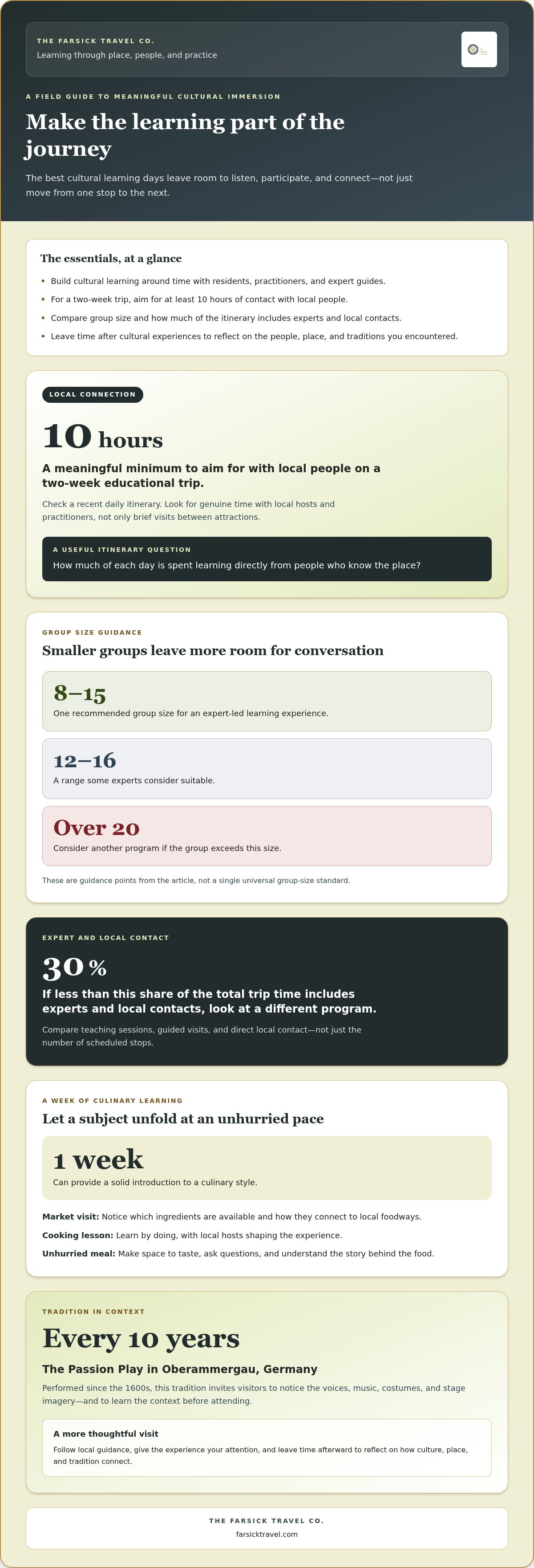
A week can provide a solid introduction to a culinary style. Build the days around a market visit, cooking lesson, and unhurried meal that offers local context. Find out what participants will do themselves and whether local hosts shape the experience. A language exchange or craft workshop can also turn observation into participation.
Choose experiences that respect local customs and give hosts a meaningful role. In Oberammergau, Germany, the Passion Play has been performed every 10 years since the 1600s. As the performance unfolds, listen to the voices and music, and notice how costumes and stage imagery bring the story to life. Learn the context before attending, follow local guidance, and leave time afterward to reflect on how culture, place, and tradition connect.
Expert-Led Programs
An expert-led program should make the subject visible in daily activities, not just in lectures. Compare the itinerary’s teaching sessions, guided visits, and direct contact with local people. Review a recent daily itinerary to see how much time is devoted to learning. Over a two-week educational trip, aim for at least ten hours of contact with local people.
Group size shapes conversation and access. One recommendation is eight to fifteen travelers; some experts consider groups of 12-16 suitable. If a group exceeds twenty travelers, consider another program. Also compare how much total trip time includes experts and local contacts. If that falls below thirty percent, look at a different program.
Food offers a practical way to learn about climate, migration, and daily life. In a regional cooking class, notice which ingredients appear at the market, how the instructor prepares them, and what changes with the season. A week can introduce a culinary style, but the schedule should leave time to taste, ask questions, and understand the story behind each dish.
For an international learning vacation, consider whether language support suits your comfort and goals. A guide can interpret a conversation, while a language-focused program may encourage you to practice directly with residents. Choose smaller, locally rooted experiences where possible, arrive ready to listen, and ask permission before photographing people. These habits support respectful exchange across countries.
Before choosing, compare the group size, expert contact, and local participation in each itinerary. For a more personal rhythm, The Farsick Travel Co. can create a culture-led custom itinerary around the places and people you hope to learn from.
University alumni and continuing education trips
University alumni and continuing education trips bring a subject beyond the lecture hall. They can reconnect former classmates, introduce learners to scholars, or give adults a focused way to follow their curiosity. Formats vary: some trips center on expert talks, while others use museums, landscapes, and local encounters as the learning space. Choose according to the subject and the kind of participation you want.
Alumni programs often build a shared itinerary around a university’s academic strengths or community. Oxford University offered summer programs in 2020, an example of learning opportunities connected with a university setting. When comparing programs, look at who teaches, how visits support the subject, and whether participants have time to discuss what they encounter. A schedule with talks and site visits can feel very different from a classroom-based course.
Domestic educational trips can explore national history, regional ecology, architecture, or food without crossing an ocean. A history-focused road trip, for example, might pair a museum visit with a walk through the landscape it interprets. Plan the route around one central question, then leave time for an expert-led visit and independent reflection. Check seasonal conditions and opening schedules before setting the pace, and pack for indoor learning and outdoor stops.
Trips across the globe place a subject in a wider context. A Spanish language itinerary, for instance, might combine structured lessons with everyday practice at markets, cafés, and community events. Gary Milby retired from teaching in 1997 and later arranged trips for members of his local retirees’ education association for more than a decade. His example shows how a shared scholarly interest can shape travel beyond a campus.
For a more personal route, list the subject, the places that illuminate it, and the kind of teaching you prefer. Then compare alumni offerings with continuing education programs: note the balance between lectures, guided visits, and free time. Lee Ann Prielipp has traveled and learned since retiring in 2001, showing that study can continue through changing life stages. A road scholar can be a beginner, a returning student, or an experienced learner.
Before choosing, map the daily rhythm against your energy and curiosity. A morning lecture followed by an afternoon visit may suit a history learner; a language student may prefer regular practice and slower days. Review transport between sites, independent time, and likely seasonal conditions. These details help you decide whether a domestic journey or an international program will deepen your chosen subject.
Educational tour packages and destinations
Educational travel programs range from focused, single-region itineraries to routes linking several learning sites. Choose based on the subject you want to explore and the pace you can enjoy.
Educational Tour Packages
Compare a package’s teaching approach, daily schedule, and time spent at each destination. An 11-day Imperial and Scenic China Family Tour offers one example of a defined route; an eight-day Cairo-Aswan-Luxor itinerary links several historic places. Those durations describe different travel plans, not how much you’ll learn. Look for a clear connection between each stop and the program’s central subject.
Check how the schedule balances outdoor visits, indoor learning, and rest. For archaeological sites, plan outdoor exploration early in the day, then use warmer or busier hours for indoor interpretation when the itinerary allows. A museum visit can add context before or after a site, rather than becoming another rushed stop. Bring comfortable walking shoes, a layer for changing conditions, and a notebook for questions.
Choosing by Subject, Age, and Experience
Start with your interest, then assess whether the program matches your experience. A traveler new to mythology might value guided interpretation on a Greece itinerary; someone with prior study may prefer time for independent reading and discussion. Consider walking demands, lesson style, and expected preparation. Age alone won’t tell you whether the pace or teaching approach is a good fit.
Ask what participants actually do each day. A culinary program should make room for tasting or practice, while a history itinerary should connect expert explanations with places and objects. Review the schedule for quiet time as well as organized activities. That balance can help solo learners and couples stay engaged without turning every hour into a lesson.
Seasonal conditions can shape your comfort and what you experience. Before choosing dates, compare expected weather and daylight with the itinerary’s outdoor activities, and pack accordingly. For a popular site, choose an earlier entry when available; save flexible indoor visits for the busiest part of the day. These choices can make time at the destination feel less hurried.
Before committing, make a simple comparison: write down the program’s subject, teaching format, daily pace, physical demands, and time for independent exploration. Mark the details that matter most. A route through several countries may appeal to broad curiosity, while a single-region itinerary can leave more room to study one subject closely.
Benefits of adult educational travel
A two-to-three-week educational trip can offer depth that helps justify its cost. The benefit comes from sustained attention: participants can return to a subject over several days, connect new ideas, and notice details missed during a quick visit. Abroad, a morning with an archaeological guide followed by time to sketch or take notes can turn a museum visit into a fuller learning experience.
That rhythm can build practical skills as well as knowledge. A traveler studying photography, for example, can practice observing light during a walk, then review images with an instructor. Someone interested in local ecology can learn to identify plants along a guided trail and apply that knowledge on later walks. Learning becomes active, and the landscape becomes part of the lesson.
Shared study also creates opportunities to connect. A discussion after a guided visit lets participants compare interpretations and ask questions they might not raise alone. In a small group, those exchanges can continue over a meal or an unhurried afternoon. For solo travelers, a shared subject can provide structure and companionship without making every moment social.
Educational travel can deepen cultural understanding when the itinerary includes local voices. A craft demonstration, community-led walk, or conversation about regional food can reveal how knowledge is practiced in daily life. The value is not simply collecting facts; it’s learning to notice context, listen carefully, and approach unfamiliar customs with respect. Ask before photographing people, follow a guide’s direction, and leave natural spaces as you found them.
For learners returning to study after a long pause, travel can make curiosity tangible. A lecture about archaeology has one texture; standing near a site and hearing how researchers interpret its layers gives the subject a physical setting. Participants can bring home new questions, field notes, and skills to keep developing through reading, practice, or local classes.
A learning trip can also suggest ways to keep exploring after you return. Note the names of libraries, community groups, or professional associations connected to your subject. Later, use one as a starting point for finding a talk, discussion group, or hands-on opportunity to extend your learning beyond the itinerary.
To make the experience worthwhile, write down one learning goal before choosing a trip. Compare the daily schedule with the time it allows you to practice, reflect, and engage with local people. A program with fewer stops can offer more room to absorb a subject than a packed itinerary. The best measure is what you understand and carry forward afterward.
When you book through The Farsick Travel Co., you can plan a learning-focused custom itinerary tailored to your specific interests.
The Farsick Travel Co.: Custom Travel Planning
The Farsick Travel Co. can shape a learning trip around your interests, preferred pace, and way of traveling. Its Custom Travel Planning brings the details together, allowing time for a class, local encounter, or outdoor exploration to fit naturally into the itinerary.
Turn to this approach when you know what you want to learn but need help shaping the journey around it. Solo Travel Experiences support independent travel, while Skillcations pair travel with practical learning. Signature Hiking & Yoga Retreats bring movement and time in nature into the experience.
Share the subject you’re curious about, the kind of days you enjoy, and what you hope to take home. Contact The Farsick Travel Co. to discuss a custom learning journey.
Let Your Next Journey Begin With Curiosity
A rewarding next step is to name what you want to carry forward. Perhaps you want to deepen a skill, understand a place through its history, or make more room for solitude and reflection. Write down the subject that keeps returning to mind, then consider what pace would help you stay engaged.
That intention can guide your choices more clearly than a destination shortlist. With educational travel for adults, the journey matters not only for what you learn, but also for how you make space to notice, practice, and connect. Let the itinerary support your curiosity rather than crowd it.
A thoughtful plan can turn that first interest into a meaningful route, with room for discovery along the way.
Your next chapter of learning can begin with one clear question and the willingness to follow it.
Frequently Asked Questions
Are Learning Vacations for Singles Worth It?
Yes, they can be worthwhile if you want focused learning alongside independent travel. A shared class or guided activity gives the day structure, while free time lets you explore at your own pace. Before choosing, find out how the program handles solo participation: some educational tours offer a roommate, while others require a single supplement. That detail can affect your comfort and trip budget.
Do Couples Benefit From Educational Vacations for Couples?
Couples can benefit when a trip offers a shared interest without requiring identical preferences. One partner might enjoy a morning architecture tour while the other prefers a slower start, then both meet for a cooking lesson. Compare the schedule for flexibility and meaningful time together. Agree beforehand on how much structured learning you want, and leave space for each person to follow a personal curiosity.
How Beneficial Are Learning Vacations for Adults?
They can turn a passing interest into something you can practice and explain. After a ceramics workshop, for example, you might recognize techniques in local pottery and continue experimenting at home. The value depends on what you engage with during the trip and how you use it afterward. Keep a small journal of questions, observations, and new skills, then choose one idea to pursue when you return.
How Do You Choose an Educational Travel Program?
Begin by writing down what you want to learn and how you prefer to learn it. Compare programs by instructor-led time, hands-on activities, independent exploration, daily pace, and expected prior experience. A beginner interested in birding may want guided identification walks; an experienced birder may prefer habitat-focused field sessions. Check that the itinerary allows time for practice, not just listening and moving between sites.
What Types of Educational Experiences Can I Expect on a Learning Vacation?
Experiences may include talks, workshops, guided site visits, field observation, language practice, and demonstrations by local practitioners. A photography-focused trip, for instance, could combine a lesson on composition with time to photograph changing light in a quiet neighborhood. Some programs also include discussion or reflection sessions. Read the daily schedule closely to see how instruction and firsthand activity fit together.
What Is Educational Travel for Adults?
Educational travel for adults is a trip organized around learning, with travel providing the setting for study and practice. It may take the form of a course, a specialist-led itinerary, or hands-on skill-building. What distinguishes it from a conventional vacation is the learning intention: participants travel with a subject or question in mind and make time to engage with it.
What Types of Educational Travel Programs Are Available for Adults in the United States and Abroad?
Options include university alumni journeys, continuing education trips, cultural programs, language study, culinary workshops, and nature-based learning. Within the United States, a program might explore regional ecology or local history. Abroad, a course might pair language lessons with daily conversation or archaeological study with guided visits. Compare the teaching format and subject matter rather than assuming one destination offers a better learning experience.
How Do I Choose and Book a Reputable Educational Travel Program for Adults?
Read the itinerary from start to finish and note the learning activities, free time, transport, lodging, and inclusions. Look for clear descriptions of instructors, local involvement, physical demands, and cancellation terms. Compare the schedule with your goals, then review the booking terms before committing. Keep copies of the itinerary and booking details together, and share your travel plans with someone you trust.
Article by
Ursula Akin
Ursula Akin created The Farsick Travel Co. to help travelers step away from rigid, multi-stop checklists and step into intentional, deeply rooted experiences. Specializing in custom travel design, solo escapes, and curated retreats, Ursula combines local insights with leave-no-trace ethics to turn wanderlust into seamless, unforgettable journeys.
Disclaimer
The information provided on this website and within our articles is for general informational and inspirational purposes only. While we make every effort to ensure accuracy regarding travel logistics, recommendations, and local details, conditions can change rapidly. Readers are encouraged to verify current travel requirements, weather, safety advisories, and local regulations independently. The Farsick Travel Co. is a travel design and curation service and is not responsible for any actions, changes, or incidents occurring during independent travel.


