
The most meaningful trip isn’t always the one that covers the most ground. Immersive travel experiences in the USA invite you to connect with a place through its people, culture, and natural rhythms, rather than simply moving from one attraction to the next. The difference is time: enough to notice, listen, and take part.
If you want more than a checklist of sights, the right trip can make room for shared stories, unhurried afternoons, and a deeper relationship with the landscape. This guide explains what immersive travel means and how it can take shape across the USA, from family and cultural journeys to wildlife encounters, hiking, and story-driven escapes. You’ll also find practical ways to shape a thoughtful itinerary, travel with care, and choose a pace that leaves room for discovery.
Key Takeaways
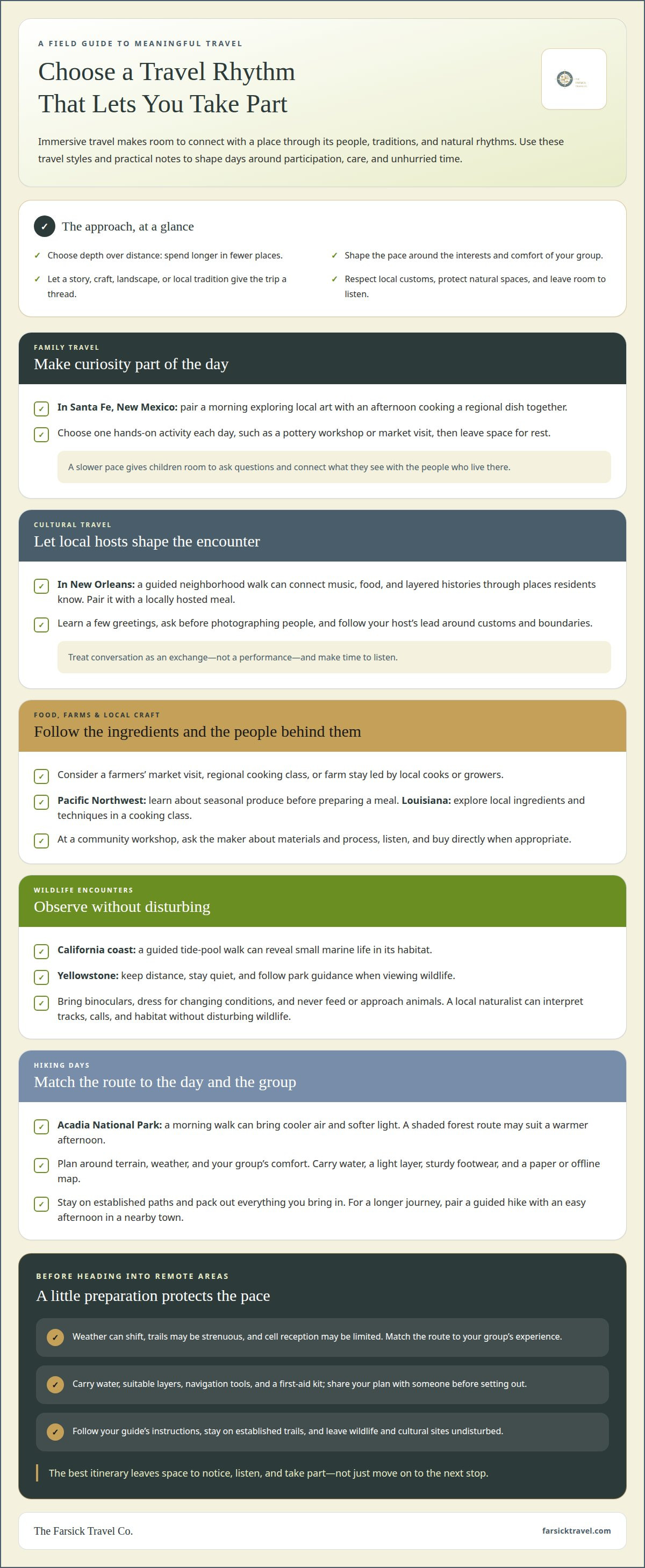
- Choose depth over distance: spending longer in fewer places creates more room for local connection and reflection.
- Shape a family, cultural, wildlife, or hiking trip around the pace and interests of the people taking part.
- Use a story, craft, landscape, or local tradition to give your itinerary a meaningful thread.
- Plan thoughtful encounters that respect local customs, protect natural spaces, and leave room for unhurried moments.
- Custom planning can help bring your interests, travel rhythm, and practical details together in one cohesive journey.
What is an Immersive Travel Experience?
An immersive trip gives you time to engage with a destination’s people, traditions, and everyday life. Instead of racing across America to collect landmarks, you might spend a morning learning regional cooking, then share an unhurried afternoon with a local guide. The value lies in participation, not just observation. A conversation with an artisan or a story from an elder can stay with you long after the trip ends.
Lasting connections grow through attention and reciprocity. At a community workshop, ask the maker about their materials and process, listen without turning the exchange into a photo opportunity, and buy directly when appropriate. Local leaders, artisans, and elders hold knowledge that a quick stop rarely reveals. A guided walk through a historic neighborhood, for example, can connect its architecture to residents’ memories and living traditions. Leave room in your itinerary to listen, not just take part in activities.
There is no single typical cost for immersive travel experiences in the USA. Lodging, transportation, guide services, season, trip length, and personalization all shape the budget. To choose locally rooted experiences, prioritize community-run lodging and businesses, learn local expectations before arrival, and select activities led by residents. Spending directly with local makers and businesses can help keep more of your trip’s value in the destination.
For cultural immersion with Indigenous communities, look for tribally operated cultural centers and experiences explicitly led by the community. The Navajo Nation spans parts of Arizona, New Mexico, and Utah, but choose invited, community-guided experiences and follow local guidance. Respect boundaries around photography, sacred places, and stories. Access is not an entitlement.
Hands-on history works best when interpretation connects objects and places to real lives. Colonial Williamsburg in Virginia and Plimoth Patuxet in Massachusetts offer living-history settings where visitors can encounter historic buildings, crafts, and costumed interpreters. Read the daily program before arriving, choose a demonstration, and leave time to ask how a skill or household routine shaped daily life.
Local expertise can make an itinerary more personal and responsive. A guide can tailor a walking route to migration, architecture, food, or your family’s interests, then suggest a locally owned inn nearby. Homestays and community-run lodges can bring you closer to daily rhythms, from a shared breakfast to neighborhood sounds at dusk. With immersive travel experiences in the USA, a slower pace often leaves more room for these exchanges.
Remote and adventure-based trips call for practical preparation. Weather can shift, trails may be strenuous, and cell reception may be limited in wilderness areas. Match the route to your group’s experience, carry water, suitable layers, navigation tools, and a first-aid kit, and share your plan with someone before setting out. Follow your guide’s instructions, stay on established trails, and leave wildlife and cultural sites undisturbed.
Travel styles including family, cultural, wildlife, and hiking trips
A family journey becomes more engaging when children have a role beyond following adults. In Santa Fe, New Mexico, families can pair a morning exploring local art with an afternoon cooking a regional dish together. Choose one hands-on activity each day, such as a pottery workshop or market visit, then leave space for rest. A slower pace helps children ask questions and connect what they see with the people who live there.
Cultural travel works best when local hosts shape the experience. In New Orleans, a guided neighborhood walk can introduce visitors to music, food, and layered histories through places residents know. Follow it with a locally hosted meal, and treat conversation as an exchange rather than a performance. Learn a few greetings, ask before photographing people, and follow your host’s lead around customs and boundaries. These small choices can make cultural learning more thoughtful.
Popular food, farm, and culinary experiences across the USA include farmers’ market visits, regional cooking classes, and farm stays. In the Pacific Northwest, travelers might learn about seasonal produce before preparing a meal; in Louisiana, a cooking class can introduce local ingredients and techniques. Choose experiences led by local cooks or growers, and ask how the meal reflects the place.
Wildlife travel asks for patience and care. On California’s coast, a guided tide-pool walk can reveal small marine life in its habitat; in Yellowstone, wildlife viewing calls for distance, quiet, and respect for park guidance. Bring binoculars, dress for changing conditions, and never feed or approach animals. A local naturalist can help interpret tracks, calls, and habitat without disturbing wildlife.
For hiking, plan the day around terrain, weather, and your group’s comfort. A morning walk in Acadia National Park can offer cooler air and softer light, while a shaded forest route may suit a warmer afternoon. Carry water, a light layer, sturdy footwear, and a paper or offline map. Stay on established paths and pack out everything you bring in. For a longer journey, pair a guided hike with an easy afternoon in a nearby town.
Locally designed experiences can deepen your understanding of a region’s language and traditions. Before visiting a community market, learn how to greet vendors and ask permission before taking photos. A local guide can explain the context behind a craft or dish, while a hosted meal creates room for genuine conversation. These encounters may challenge assumptions and invite you to listen more carefully.
For a trip shaped around your family’s interests, cultural curiosity, or preferred trail rhythm, consider personalized itinerary planning. Thoughtful pacing leaves room for learning, connection, and the unexpected details that make a place memorable.
Immersive travel can involve cooking with local communities, practicing the local language, participating in cultural traditions, or supporting grassroots initiatives. These exchanges can deepen your appreciation of customs, traditions, and ways of life.
Story-driven travel adventures
A story gives an itinerary a thread, turning separate stops into one unfolding journey. Begin with a theme: rail travel, regional art, desert landscapes, or food traditions. Then choose places that reveal different parts of it, rather than adding stops simply to fill the day. In the American Southwest, a traveler drawn to imaginative art might build a journey around Santa Fe, with time to explore, reflect, and notice how the city’s creative atmosphere shifts from gallery to neighborhood.
Meow Wolf’s Santa Fe exhibition offers a vivid starting point for a story about art and perception. The installation debuted in 2016, inviting visitors to move through an imaginative environment at their own pace. Rather than rushing from room to room, pause to notice details, follow a visual motif, and record what surprises you. The documentary Meow Wolf: Origin Story screened at SXSW in 2018, adding another possible layer for travelers interested in the people and ideas behind a creative project.
A railroad can carry its own narrative. The Grand Canyon Railway has carried passengers since 1901, making it a natural anchor for a journey about rail travel and the changing relationship between people and landscape. Build the day around the ride instead of treating it as a transfer: notice the transition from town to open country, keep a notebook close, and leave the next morning unhurried. A slower schedule gives the experience room to settle.
In Grand Rapids, Michigan, public art can shape a story-led city visit. A large Alexander Calder sculpture was installed downtown in 1969, while ArtPrize is held there every other year. These details offer a starting point, not a checklist. Choose a few works, walk between them, and consider how art changes the feel of streets and shared spaces. A quiet café break can create room to sketch, write, or discuss what stayed with you.
Food can become the next chapter, especially when cooking connects you with place and memory. Build an itinerary around a local market, a hands-on class, and a meal featuring regional ingredients. Leave time to ask the instructor about a technique or a dish’s background, and follow their guidance on respectful participation. Buying from local producers and choosing a locally hosted experience can direct spending toward communities while making the meal more meaningful.
To plan a story-driven trip, choose a central question and let it guide the rhythm. For example: What does this landscape make possible for the people who live here? Pair a guided experience with independent time, and avoid crowding each day with unrelated attractions. Keep a journal or share a short evening reflection with fellow travelers. These simple practices help you notice patterns and connect moments, without treating local communities or natural places as scenery.
Definition of immersive travel
Immersive travel, sometimes called slow tourism, shifts attention from collecting sights to understanding a place. Visiting a neighborhood market, learning how a regional dish is prepared, or joining a locally led walk can bring daily life into focus. The aim isn’t to do everything. It’s to notice how people, landscape, and traditions shape one another.
Consider a visit to Washington, D.C.’s Hirshhorn Museum. Its collection includes Yayoi Kusama’s first infinity room, “Phalli’s Field,” from 1965. An immersive approach means taking time with the work, noticing your own response, and learning about its context, rather than hurrying through every gallery. The same principle applies beyond museums: choose fewer experiences, then engage with them attentively.
For a practical starting point, choose a question to guide your itinerary. You might ask how a region’s landscape influences its food, crafts, or everyday routines. In Maine, for example, a coastal walk could lead to a conversation about local fishing traditions, followed by a meal featuring regional ingredients. Let the question connect activities instead of treating each stop as an unrelated attraction.
Immersion also depends on how you show up. Before attending a community event, read its public guidance, learn a respectful greeting, and ask before taking photographs. At a workshop, listen to the instructor before handling materials. These steps make an encounter more reciprocal and help you recognize that local customs aren’t performances arranged solely for visitors.
Meaningful travel makes room for reflection. After a guided walk in Philadelphia’s historic district, write down a detail you hadn’t noticed before, such as a building’s reused materials or a story about its former residents. A short journal entry can connect that observation to what you learned. Sharing reflections with a travel companion can deepen the conversation without turning local people into subjects.
Immersive experiences can include culture, nature, food, and creative work. A morning bird walk in the Everglades, for instance, asks visitors to move quietly, follow the guide’s instructions, and leave wildlife undisturbed. An afternoon cooking class offers a different kind of learning through regional ingredients and techniques. Each activity becomes more grounded when it respects the people and places involved.
To shape a memorable trip, balance guided experiences with unstructured time. Leave room after a community-led tour to explore nearby streets at a considerate pace, or keep an afternoon open after a hike. Make the itinerary flexible enough for rest and observation. Immersion isn’t a checklist; it’s a way to pay closer attention to the connections that give a destination its character.
What are the best immersive travel experiences in the USA?
The best immersive travel experiences in the USA depend on what you want to understand or feel. Start with an interest, such as coastal ecology, regional music, or mountain craft, then choose a place where you can explore it at a thoughtful pace. A trip built around that thread often feels more connected than one that moves between unrelated attractions.
For a landscape-led journey, consider the Blue Ridge Mountains. Pair a guided trail walk with a slower afternoon in a nearby town, where local makers and community businesses offer another perspective on the region. Go early for quieter trails and softer morning light. Carry water, layers, and a reusable bag, and stay on established paths to reduce disturbance to plants and wildlife.
In Alaska, a wildlife-focused itinerary can center on patient observation rather than chasing sightings. Choose a guided outing that explains habitat and animal behavior, bring binoculars, and follow your guide’s instructions about distance. Leave time afterward to reflect on what you noticed. Wildlife encounters follow nature’s rhythms, so build the day around learning rather than expecting a particular animal to appear.
For a cultural experience, explore a neighborhood through its food, music, or creative traditions. In Chicago, a locally led walk can connect public art, architecture, and the stories of the people who live there. Choose a guide with a clear local perspective, ask thoughtful questions, and support neighborhood businesses directly. A meal or workshop can add context without making the day feel packed.
Hands-on learning can make a trip feel personal. In the Pacific Northwest, a cooking class focused on regional ingredients can bring place and taste together; in the Appalachian region, a craft workshop can introduce local materials and techniques. Look for experiences led by local practitioners and read their participation guidance before booking. Arrive ready to listen, follow instructions, and let the instructor set the pace.
Nature and culture can share one itinerary. In coastal Maine, for example, a morning shoreline walk might lead into an afternoon learning about local food traditions. In New Mexico, balance a guided landscape walk with time to explore local art. Keep travel between activities manageable, leave room for rest, and choose lodging that supports nearby communities where practical.
To decide among experiences, weigh your interests, mobility, preferred pace, season, and the kind of connection you’re seeking. A useful itinerary might include a guided activity, independent exploration, and unstructured time each day. That rhythm makes room for curiosity without crowding out rest. For outdoor trips, pack layers, comfortable walking shoes, water, and a small notebook for observations.
When you work with The Farsick Travel Co. to plan a custom nature and culture itinerary, you can seamlessly blend outdoor adventures with local traditions. Tailor every day to your personal preferences, energy levels, and the amount of structure you enjoy. Some river cruises include visits to local markets and onboard cooking demonstrations, which may suit travelers who want food and place connected within one itinerary. Compare that format with a neighborhood walk or hands-on class, and choose the experience that leaves enough time to listen, ask questions, and engage with local practitioners at a comfortable pace.
The Farsick Travel Co.: Solo Travel Experiences
The Farsick Travel Co. shapes solo journeys around your interests, pace, and reasons for going. Through Solo Travel Experiences and Custom Travel Planning, a quiet stretch of coastline, a locally guided city walk, or a day on the trail can become part of a cohesive itinerary. The focus is thoughtful design, not filling every hour.
Choose personalized planning when you want meaningful experiences but need help bringing the details together. A Signature Hiking & Yoga Retreat can center your trip on movement and restoration, while a Skillcation makes learning a craft or practice part of the journey. You decide what matters most, and the itinerary takes shape around that intention.
If you’re ready to explore a solo escape or another intentional adventure, book a free discovery call with The Farsick Travel Co. to begin planning.
Let your next journey take shape with intention
Start by deciding what you want to carry home beyond photographs: a new skill, a steadier connection with nature, or a deeper understanding of a place. That intention can guide the pace, setting, and encounters that make immersive travel experiences in the USA feel personal rather than prescribed. Leave room for curiosity, rest, and an unexpected conversation.
The Farsick Travel Co. offers Custom Travel Planning, Signature Hiking & Yoga Retreats, and Solo Travel Experiences. Proposal & Honeymoon Planning and Bachelorette Party Planning bring the same considered approach to milestone journeys. Share the kind of experience you’re drawn to, from a quiet trail to independent exploration with people you care about.
Your next journey can begin with a clear intention and room to follow it.
Frequently Asked Questions
Where can visitors find immersive nature and wildlife experiences in the United States?
Look for these experiences in places where habitat and local expertise shape the activity. Olympic National Park offers a setting for exploring temperate rainforest, while Monterey Bay is known for marine wildlife viewing. Choose an outing led by a knowledgeable local guide, follow viewing-distance instructions, and avoid activities that encourage feeding or handling animals. Before you go, consider the season, terrain, and weather, then pack layers and binoculars.
How do immersive travel experiences in the USA compare with guided tours and traditional sightseeing?
Immersive travel describes the depth and intention of an experience, while a guided tour describes one way to take part. A tour can be immersive if it makes room for local perspectives, questions, and meaningful participation. Traditional sightseeing can help you get oriented, but a tightly packed schedule may leave little time to engage. For a richer visit, choose an activity that connects a place’s stories, landscape, or daily life.
Article by
Ursula Akin
Ursula Akin created The Farsick Travel Co. to help travelers step away from rigid, multi-stop checklists and step into intentional, deeply rooted experiences. Specializing in custom travel design, solo escapes, and curated retreats, Ursula combines local insights with leave-no-trace ethics to turn wanderlust into seamless, unforgettable journeys.
Disclaimer
The information provided on this website and within our articles is for general informational and inspirational purposes only. While we make every effort to ensure accuracy regarding travel logistics, recommendations, and local details, conditions can change rapidly. Readers are encouraged to verify current travel requirements, weather, safety advisories, and local regulations independently. The Farsick Travel Co. is a travel design and curation service and is not responsible for any actions, changes, or incidents occurring during independent travel.


